
Presentation of Results – Meatpacking Companies
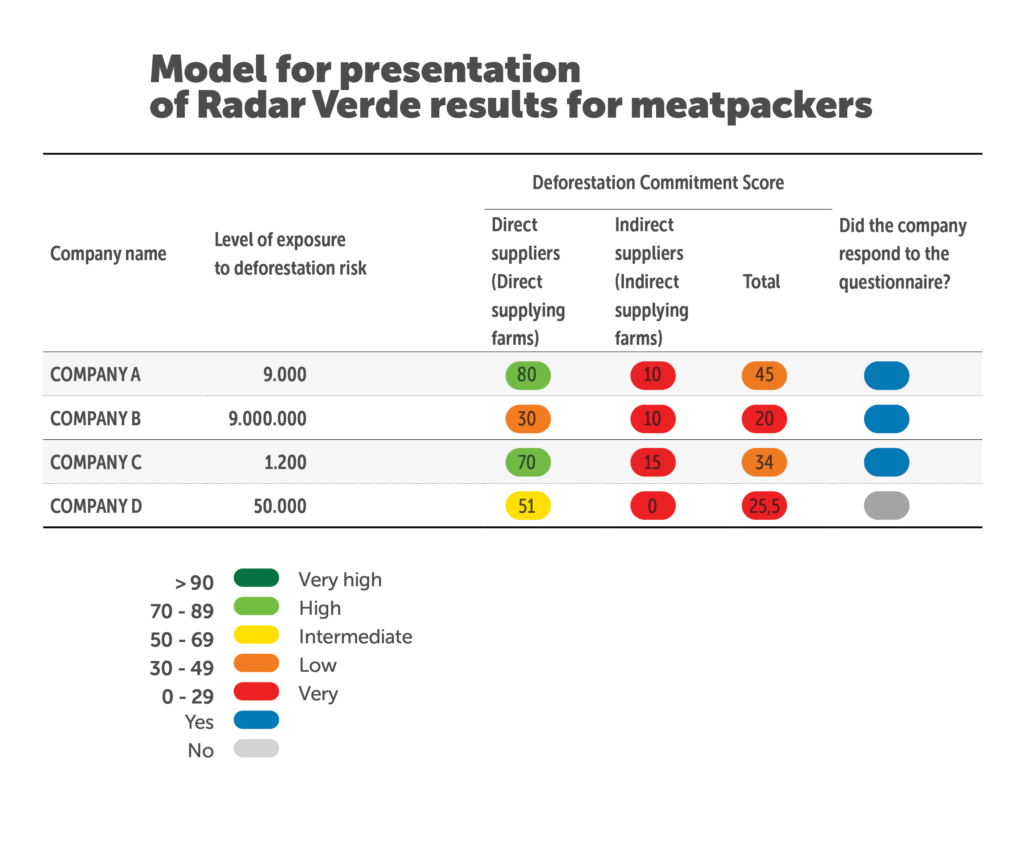
The Radar Verde results for each meatpacking company are presented in a list containing the following columns (Table 6):
Radar Verde will publish the results obtained through the company’s response to the questionnaire or through the verification of public data, regardless of the company’s consent.
Table 6. Model for presenting Radar Verde results for meatpackers
Presentation of Results – Retailers
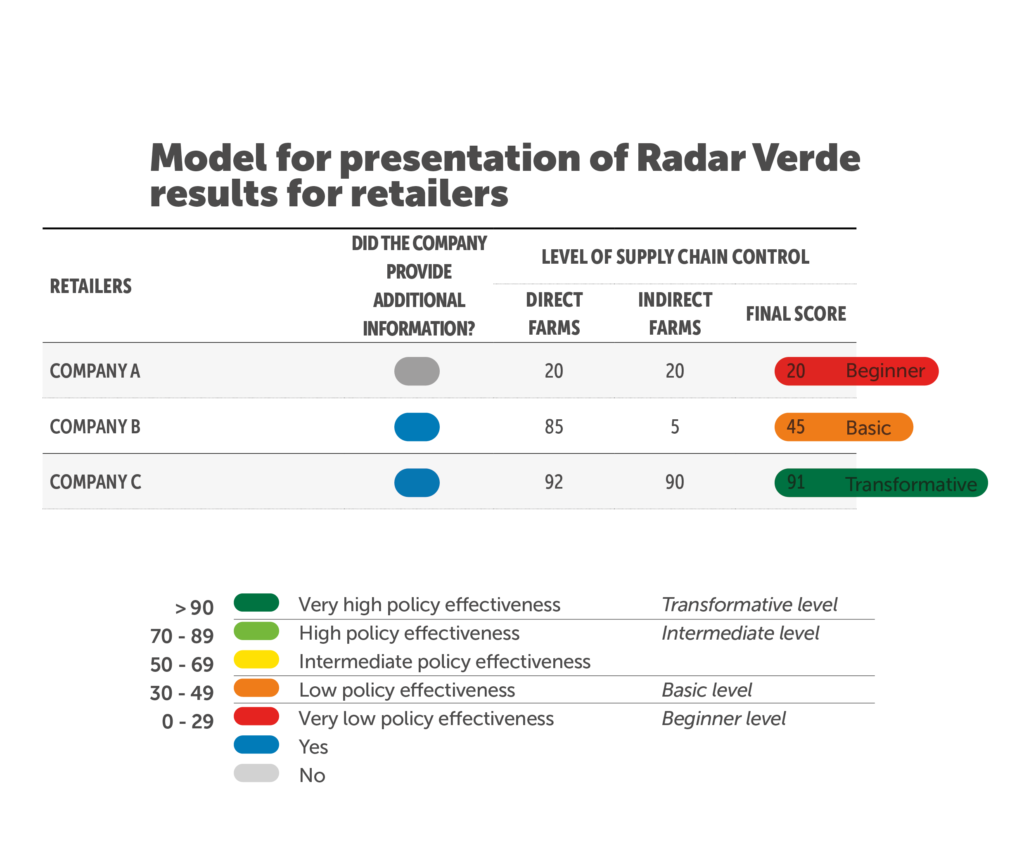
The Radar Verde results for each retail company are presented in a list containing the following columns:
Radar Verde will publish the results obtained from companies’ responses to the questionnaires and, additionally, from the verification of public data made available on their institutional websites, regardless of the consent of the companies assessed. For the retail sector, the Radar Verde scoring system assesses companies’ commitment to combating deforestation through two complementary dimensions: the Level of Supply Chain Control and the Engagement Score. The maximum score for each indicator is 100 points.
In the assessment, for the composition of the final score, the Level of Supply Chain Control will have a weight of 98%, of which 18% refers to Policy and 80% to Implementation, while the Engagement Score will account for 2% of the final score. In the results, the higher the final score, the greater the company’s effectiveness in eliminating deforestation from its supplier chain.
Depending on the effectiveness of the environmental policy implemented by the companies, they may present different levels of impact in terms of the policy’s actual capacity to promote change and prevent deforestation in their supplier chains. The Transformative Level corresponds to effectiveness above 90 points and indicates that the policy generates structural changes, redefines paradigms, and has lasting effects. The Intermediate Level corresponds to effectiveness from 50 to 89 points and indicates that the policy is successful but still requires adjustments to achieve maximum impact. The Basic Level corresponds to effectiveness from 30 to 49 points and indicates that the company’s policy has functional implementation, but with modest results and limited scope. Finally, the Initial Level corresponds to effectiveness from 0 to 29 points, meaning that the company’s policy is in the testing phase, has significant shortcomings, or lacks structure.
See the illustration of the presentation of results in Table 7 below.
Table 7. Model for presenting Radar Verde results for retailers
Este site usa cookies para melhorar a sua experiência enquanto navega pelo site. Destes, os cookies que são categorizados como necessários são armazenados no seu navegador, pois são essenciais para o funcionamento das funcionalidades básicas do site. Também usamos cookies de terceiros que nos ajudam a analisar e entender como você usa este site. Esses cookies serão armazenados em seu navegador apenas com o seu consentimento. Você também tem a opção de cancelar esses cookies. Porém, a desativação de alguns desses cookies pode afetar sua experiência de navegação.
| Cookie | Duração | Descrição |
|---|---|---|
| cookielawinfo-checkbox-analytics | 11 months | Este cookie é definido pelo plug-in GDPR Cookie Consent. O cookie é usado para armazenar o consentimento do usuário para os cookies na categoria "Analytics". |
| cookielawinfo-checkbox-functional | 11 months | O cookie é definido pelo consentimento do cookie GDPR para registrar o consentimento do usuário para os cookies na categoria "Funcional". |
| cookielawinfo-checkbox-necessary | 11 months | Este cookie é definido pelo plug-in GDPR Cookie Consent. Os cookies são usados para armazenar o consentimento do usuário para os cookies na categoria "Necessário". |
| cookielawinfo-checkbox-others | 11 months | Este cookie é definido pelo plug-in GDPR Cookie Consent. O cookie é usado para armazenar o consentimento do usuário para os cookies na categoria "Outros. |
| cookielawinfo-checkbox-performance | 11 months | Este cookie é definido pelo plug-in GDPR Cookie Consent. O cookie é usado para armazenar o consentimento do usuário para os cookies na categoria "Desempenho". |
| viewed_cookie_policy | 11 months | O cookie é definido pelo plug-in GDPR Cookie Consent e é usado para armazenar se o usuário consentiu ou não com o uso de cookies. Ele não armazena nenhum dado pessoal. |