


The Level of Supply Chain Control
The Supply Chain Control Level assesses meatpacking plants’ commitment to monitoring and avoiding the purchase of beef linked to deforestation. It is used to calculate companies’ scores for the Level of Commitment Against Deforestation. The score is based on an analysis of public information and responses to the Radar Verde questionnaire sent to companies.
After 30 days—the period set for submitting responses and evidence—the Radar Verde team analyzes and classifies the establishments. Companies with a high degree of control demonstrate that they do not purchase meat from direct or indirect suppliers linked to deforestation.
Below, we detail the criteria used to calculate the Chain Control Level score.
Evaluation Criteria for Meatpackers
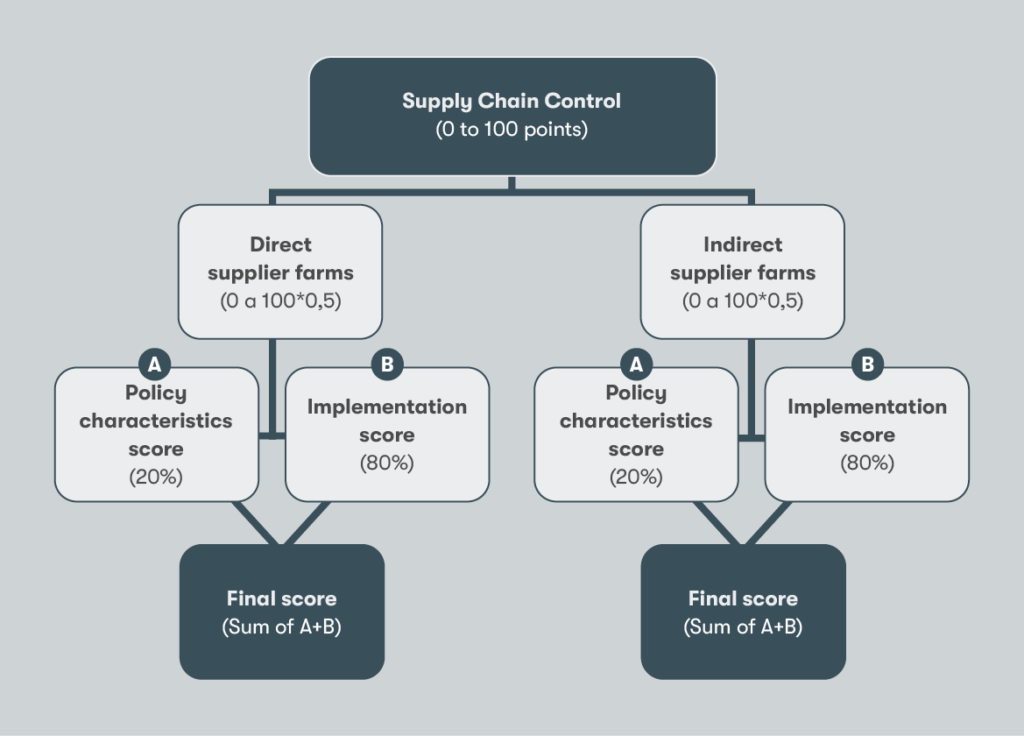
The total score is the weighted sum of two aspects:
The score is divided into:
Score Calculation
The Control Level score is calculated based on the following factors:
Control Policy Characteristics
This section evaluates the structure and scope of the policy and accounts for 20% of the total score. The calculation includes:
Control Policy Implementation
Implementation accounts for 80% of the total score and assesses whether companies actually enforce their policies. The factors considered are:
If only part of the operations is audited, the score is proportional.
This process allows Radar Verde to assess, in a transparent and objective manner, companies’ commitment to sustainability in the beef supply chain.
Figure 2. Components of the Chain Control Level calculation
The Supply Chain Control Level Questionnaire
The questionnaire for assessing the Supply Chain Control Level is administered to meatpacking plants and is divided into two main sections: policy characteristics and implementation performance.
Meatpacking companies are evaluated based on the policies applicable to their direct and indirect suppliers. The questionnaire includes questions about the requirements imposed on supplier farms to ensure that:
The questionnaire also verifies the policy’s coverage, that is, how many of the company’s units it applies to. Additionally, meatpacking plants must submit independent audits attesting to the effective implementation of these policies.
Level of Commitment Against Deforestation
The Level of Commitment Against Deforestation considers two main analytical axes:
In the assessment, points are distributed across each evaluated item as follows:
Social and environmental policy (20% weighting): the quality of the anti-deforestation policy and the scope of its application are assessed, with the result adjusted by the level of ambition of the company’s commitment, which corresponds to the type of policy adopted: zero-deforestation policies receive a factor of 1, while policies restricted solely to illegal deforestation receive a factor of 0.8.
Independent audits (80% weighting): the results and coverage of external audits conducted by companies are considered, with scores also adjusted according to the level of ambition of the company’s commitment, applying a factor of 1 for zero-deforestation policies and 0.8 for policies limited to illegal deforestation.
The score is calculated separately for direct and indirect farms in the meatpacking plants’ supply chain and is subsequently combined, with equal weight assigned to both links (50%). This approach rewards companies with more robust commitments and encourages greater transparency and control throughout the entire production chain.
Este site usa cookies para melhorar a sua experiência enquanto navega pelo site. Destes, os cookies que são categorizados como necessários são armazenados no seu navegador, pois são essenciais para o funcionamento das funcionalidades básicas do site. Também usamos cookies de terceiros que nos ajudam a analisar e entender como você usa este site. Esses cookies serão armazenados em seu navegador apenas com o seu consentimento. Você também tem a opção de cancelar esses cookies. Porém, a desativação de alguns desses cookies pode afetar sua experiência de navegação.
| Cookie | Duração | Descrição |
|---|---|---|
| cookielawinfo-checkbox-analytics | 11 months | Este cookie é definido pelo plug-in GDPR Cookie Consent. O cookie é usado para armazenar o consentimento do usuário para os cookies na categoria "Analytics". |
| cookielawinfo-checkbox-functional | 11 months | O cookie é definido pelo consentimento do cookie GDPR para registrar o consentimento do usuário para os cookies na categoria "Funcional". |
| cookielawinfo-checkbox-necessary | 11 months | Este cookie é definido pelo plug-in GDPR Cookie Consent. Os cookies são usados para armazenar o consentimento do usuário para os cookies na categoria "Necessário". |
| cookielawinfo-checkbox-others | 11 months | Este cookie é definido pelo plug-in GDPR Cookie Consent. O cookie é usado para armazenar o consentimento do usuário para os cookies na categoria "Outros. |
| cookielawinfo-checkbox-performance | 11 months | Este cookie é definido pelo plug-in GDPR Cookie Consent. O cookie é usado para armazenar o consentimento do usuário para os cookies na categoria "Desempenho". |
| viewed_cookie_policy | 11 months | O cookie é definido pelo plug-in GDPR Cookie Consent e é usado para armazenar se o usuário consentiu ou não com o uso de cookies. Ele não armazena nenhum dado pessoal. |