Full Results
The analysis used publicly available information and questionnaires sent to companies. As no company responded to the questionnaire, the results reflect only publicly available evidence. This procedure is consistent with the Radar Verde methodology, which combines voluntary company responses with information available on websites, public documents, and independent audits (Radar Verde, 2025b, 2026b).
The results are presented with the company name, score, and color classification in the Deforestation Commitment Score, in addition to questionnaire response status. The color classification helps readers quickly interpret demonstrated performance: red indicates a very low level of commitment; orange indicates a low level; other ranges would indicate moderate, high, or very high levels, where applicable.
The assessment considers two main components:
- Deforestation policy: verifies whether the company has public, clear, and comprehensive rules to avoid purchasing cattle associated with deforestation.
- Policy implementation: verifies whether there is evidence that these rules are applied in practice, based on public data and independent audit results.
The final score considers supply chain control over both direct suppliers and indirect suppliers, since deforestation risk may occur at any stage of the animal’s life. A company that adopts monitoring limited to direct suppliers may fail to identify irregularities occurring on prior farms. For this reason, the Radar Verde assessment differentiates supply chain control over direct suppliers from supply chain control over indirect suppliers.
Map 1 presents the spatial distribution of the assessed meatpacking plants located in the Cerrado biome and their respective Deforestation Commitment Scores regarding direct suppliers. A strong concentration of facilities can be observed in the Central-West and Southeast regions, particularly in the states of Mato Grosso, Goiás, Mato Grosso do Sul, and São Paulo, which account for a large share of national cattle production. The color classification indicates that most facilities demonstrate very low levels of commitment (red), highlighting weaknesses in socio-environmental control throughout the supply chain. Conversely, a limited number of meatpacking plants show higher levels of commitment (green), suggesting the adoption of more robust monitoring practices for direct suppliers by these companies. Overall, the map highlights the predominance of very low levels of effectiveness in deforestation control policies, reinforcing the need for advances in governance across the cattle supply chain in the Cerrado.
Map 1. Performance of beef companies assessed in the Cerrado biome in the Deforestation Commitment Score regarding direct suppliers
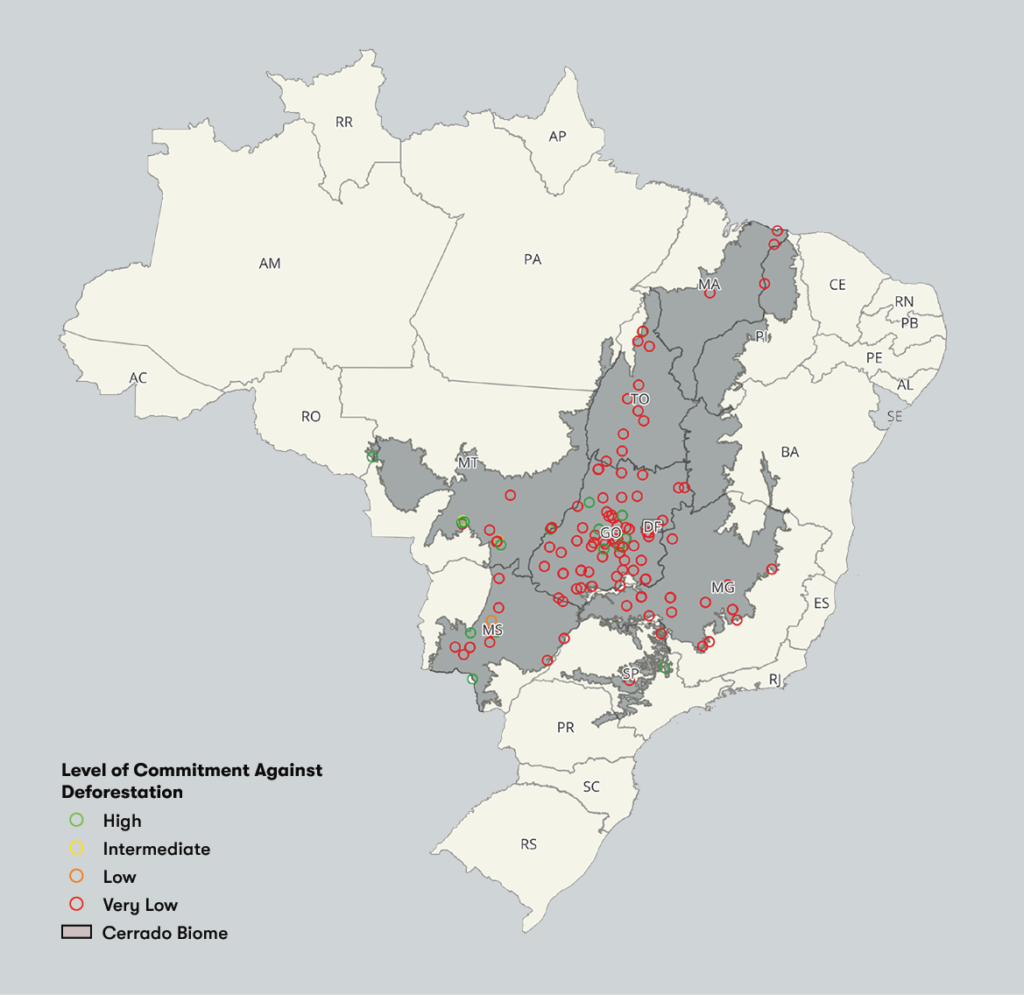
Source: Radar Verde Cerrado 2026, using data from the Federal Inspection System (SIF) and State Inspection Systems (SIE), 2025. Map 2 presents the spatial distribution of the assessed meatpacking plants located in the Cerrado biome and their respective Deforestation Commitment Scores regarding indirect suppliers. As observed in the previous map, there is a strong concentration of facilities in the Central-West and Southeast regions, particularly in the states of Mato Grosso, Goiás, Mato Grosso do Sul, and São Paulo. However, unlike the performance observed for direct suppliers, all assessed facilities demonstrate very low levels of commitment (red) in the monitoring of indirect suppliers. This result highlights a vulnerability in supply chain traceability, since indirect suppliers represent an important stage in cattle origin, where animals remain during the breeding and rearing periods and are frequently associated with higher deforestation risk. Overall, the map reinforces that the absence of effective supply chain control mechanisms over indirect suppliers constitutes one of the main challenges to the effectiveness of socio-environmental policies in the cattle supply chain in the Cerrado.
Map 2. Performance of beef companies assessed in the Cerrado biome in the Deforestation Commitment Score regarding indirect suppliers
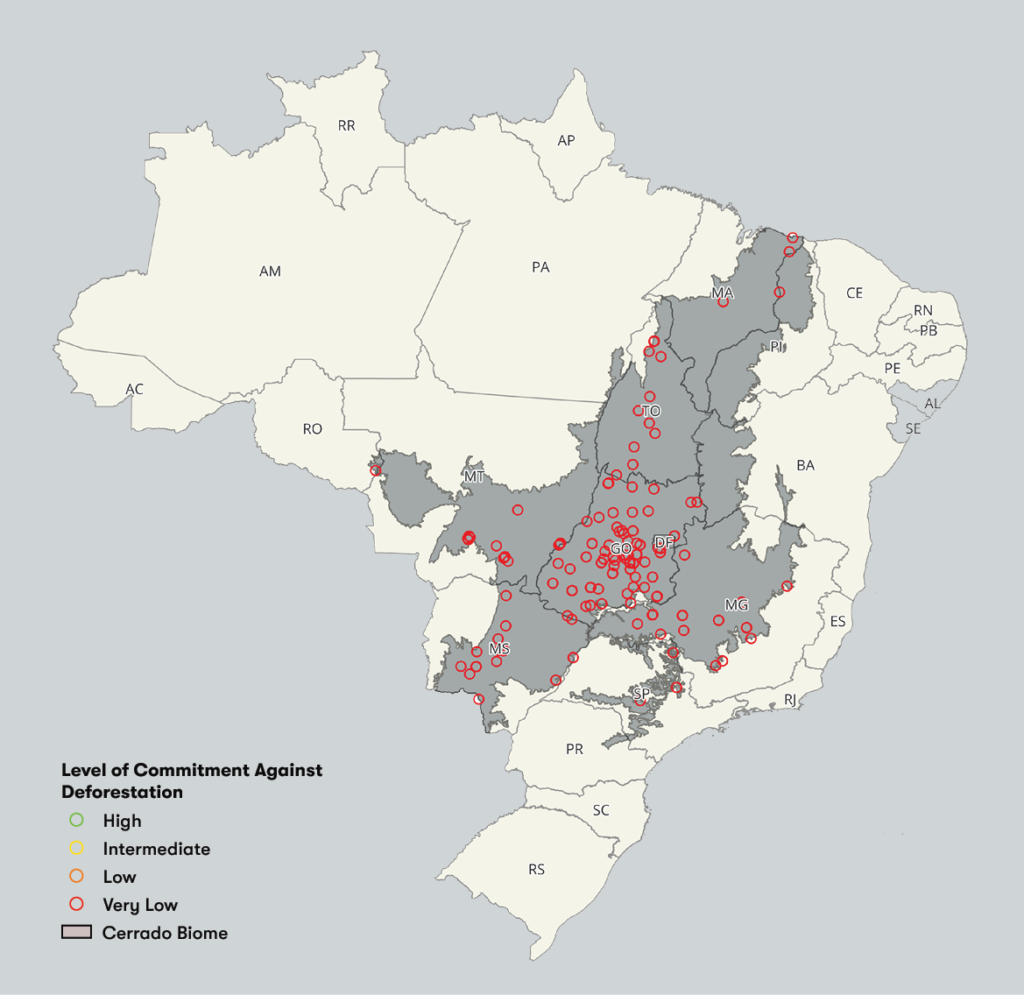
Source: Radar Verde Cerrado 2026, using data from the Federal Inspection System (SIF) and State Inspection Systems (SIE), 2025. Map 3 below presents the spatial distribution of the assessed meatpacking plants in the biome and their respective Deforestation Commitment Scores, considering the overall score, which reflects the average company performance in supply chain control over direct suppliers and indirect suppliers. The classification indicates that most meatpacking plants demonstrate very low levels of commitment (red), even when considering the average between the two types of suppliers, while a smaller share demonstrates low performance (orange). This result shows that the progress observed in the monitoring of direct suppliers is insufficient to raise overall company performance, which is significantly affected by the absence of supply chain control over indirect suppliers. Overall, the map reinforces the predominance of low levels of effectiveness in socio-environmental policies, highlighting the need for improved full traceability and greater supply chain monitoring and control across the cattle supply chain in the Cerrado.
Map 3. Performance of beef companies assessed in the Cerrado biome in the Deforestation Commitment Score regarding the overall score (direct and indirect suppliers)
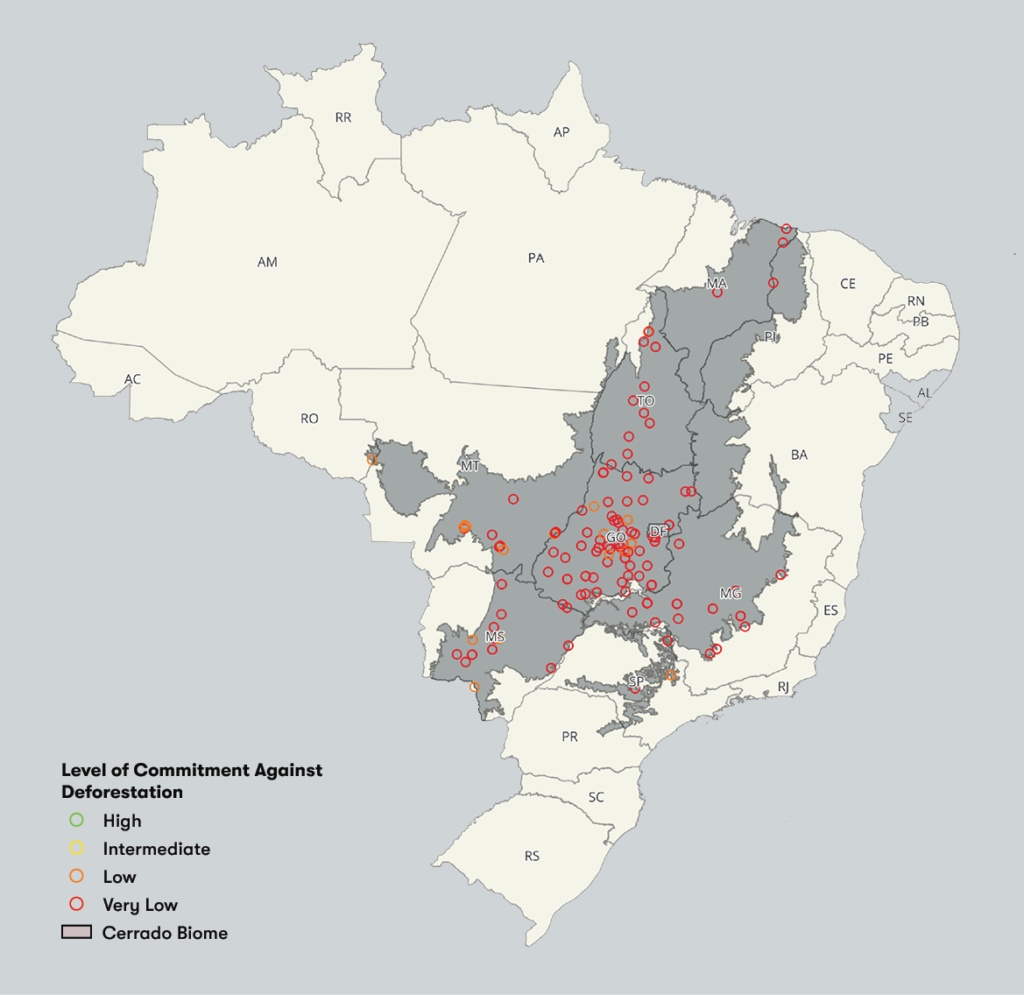
Source: Radar Verde Cerrado 2026, using data from the Federal Inspection System (SIF) and State Inspection Systems (SIE), 2025. Companies with Independent Audits
Independent audits are important because they make it possible to verify, through a third party, whether the socio-environmental criteria declared by companies are being applied in cattle purchases. In the cattle supply chain, these audits may assess whether the meatpacking company has blocked suppliers associated with deforestation, environmental embargoes, overlap with protected areas, slave labor, or other irregularities. The Federal Public Prosecutor’s Office states that the Legal Meat TACs in the Amazon include commitments to verify whether supplier farms are free from illegal deforestation, overlap with Indigenous lands and conservation units, environmental embargoes, and records on the “dirty list” for slave labor (MPF, 2026).
The existence of an audit, however, does not automatically solve all traceability challenges. The usefulness of an audit depends on its territorial scope, the criteria assessed, the quality of available data, and whether indirect suppliers are included. For this reason, Radar Verde considers independent audits as relevant evidence, while also verifying whether they cover the Cerrado and whether they reach the supply chain with sufficient scope.
Table 7. Audited beef companies, geographic coverage, and responsible audit firms
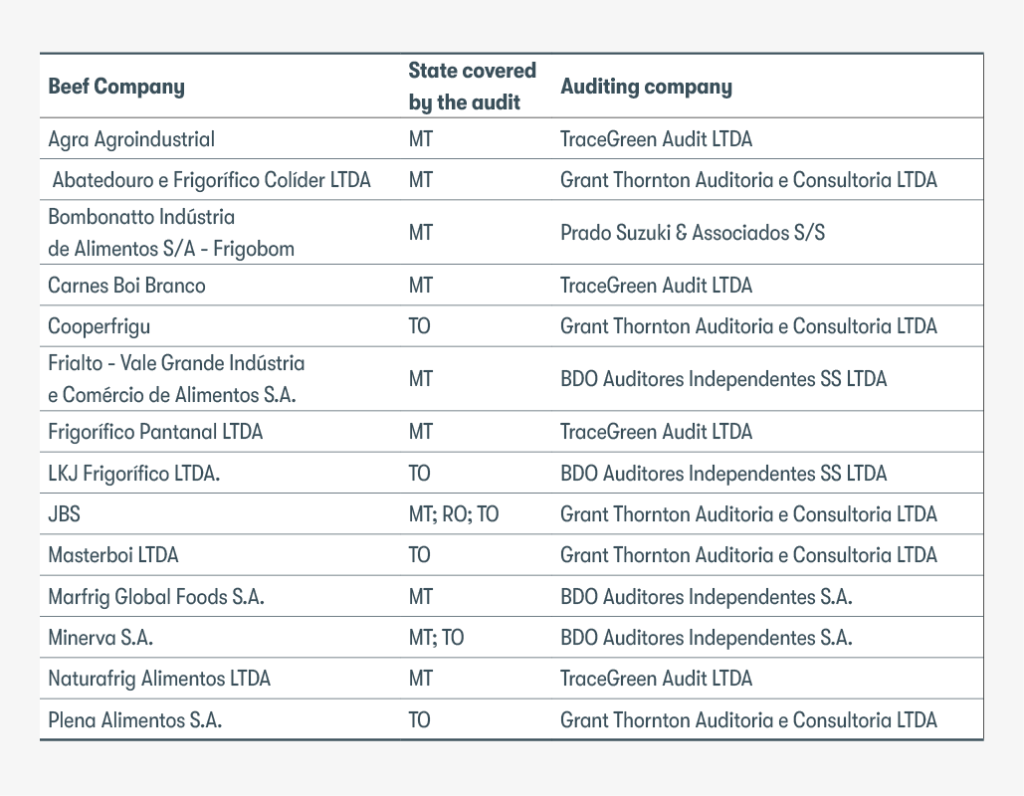
Source: MPF & Boi na Linha, 2025. Limitations of Beef Company Monitoring in the Cerrado
Monitoring of the cattle supply chain in the Cerrado faces a structural limitation that must be understood beyond the numbers: most control systems developed to date were created to respond to deforestation in the Amazon. The Cattle TACs, audit protocols, and supplier monitoring systems were built over years of pressure concentrated in that biome, driven by the Federal Public Prosecutor’s Office, civil society organizations, and international buyers demanding guarantees regarding beef origin. The result was a reasonably developed set of tools for the Amazon, but one that was not designed for the specificities of the Cerrado.
These specificities matter. In the Cerrado, as already discussed, a significant share of deforestation occurs legally on private rural properties. This means that verifying whether illegal deforestation has occurred is not sufficient: it is also necessary to determine whether the company has a policy to avoid recent conversion of native vegetation even when legally authorized, if that is the commitment it has publicly assumed. This is a more demanding and more difficult criterion to verify than simple legal compliance.
The data illustrate the scale of the challenge. The Cerrado contains 1,365,597 farms, of which 973,705, or 71%, have pasture areas of at least one hectare. To understand what this means in monitoring terms, it is necessary to consider where these farms are located. Only 209,481 of them, or 22% of the total with pasture, are located within the Legal Amazon, which is precisely the region where meatpacking company traceability systems have historically been concentrated. The remaining 764,224 farms with pasture, representing 78% of the total, are located outside this boundary and, in practice, beyond the effective reach of any existing monitoring mechanism.
Put simply, the vast majority of properties potentially supplying cattle in the Cerrado operate without any effective verification by beef companies. Each of these properties represents a potential entry point for cattle originating from deforested areas into the formal supply chain, without any effective oversight.
This gap is not accidental. It derives directly from the way deforestation commitments have been structured over the years: restricted to the Legal Amazon and focused almost exclusively on direct suppliers, that is, the farm selling cattle directly to the meatpacking company. In the Cerrado, where 70% of pasture farms are concentrated outside the Legal Amazon, monitoring is minimal or simply non-existent.
The problem deepens when examining the indirect supply chain. Indirect suppliers are the farms through which the animal passed before reaching the direct supplier, during the breeding and rearing stages. These properties are subject to a much lower level of monitoring than direct suppliers and, in most cases, are not monitored at all. Considering that the Cerrado contains nearly one million pasture farms, the absence of deforestation commitments covering this indirect supply chain makes supply chain control structurally insufficient: even if a meatpacking company verifies the farm selling directly to it, the animal may have passed through several other properties beforehand, none of which were verified.
For effective supply chain control to advance in the Cerrado, beef companies will need to adapt their traceability systems to the biome by incorporating land tenure databases, environmental data, animal transit information, Rural Environmental Registry records, and criteria specific to the region’s characteristics. Without this adaptation, most of the supply chain will remain beyond the effective reach of any verification, regardless of the commitments publicly declared by companies.
Figure 3. Farms located in the Cerrado biome that are potentially monitorable by meatpacking companies that signed Cattle Terms of Adjustment of Conduct (TACs) covering the Legal Amazon
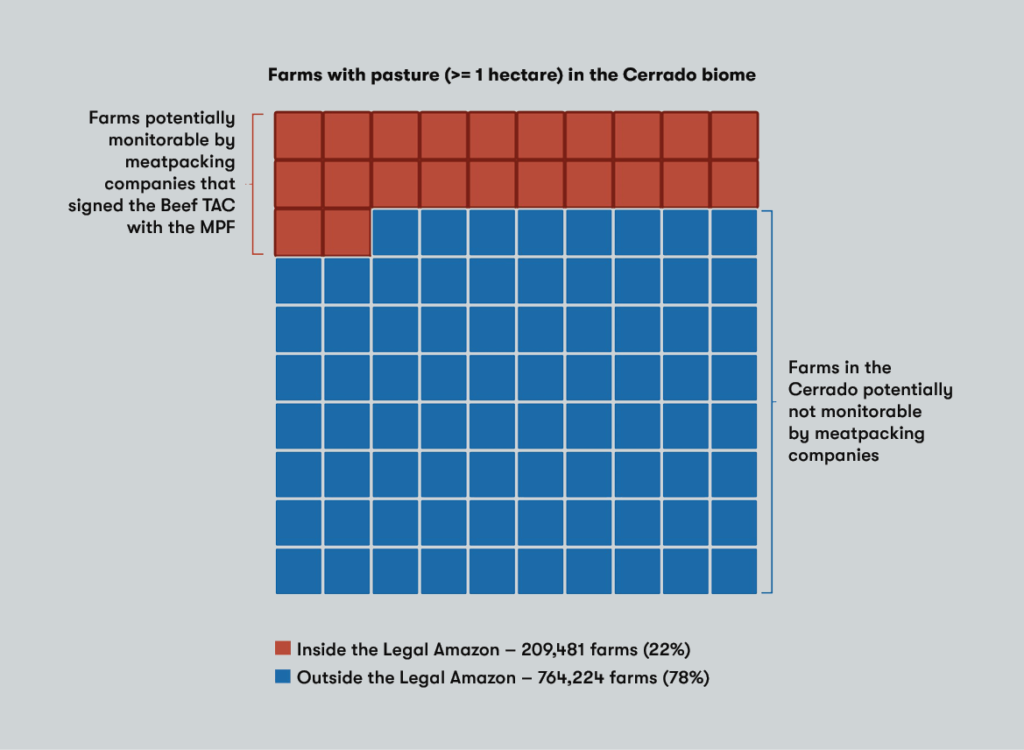
Source: MapBiomas (2024) and SICAR (2025).